本页未翻译。您正在浏览的是英文版本。

"Solargis Forecast has delivered an 8-12% improvement in our fiscal outcome - driven directly by a reduction in balancing costs.”
Prifti Eris-Theodhoros
Mechanical Engineer, Solar Energy Soumpasis (SES)

About Solar Energy Soumpasis

Solar Energy Soumpasis (SES) is an EPC contractor, PV operator, energy supplier, and licensed Renewable Energy Source (RES) aggregator based in northern Greece.

SES develops, constructs, operates, and manages PV and energy storage assets, providing integrated solutions across project development, construction, operation, asset management, and market representation.

Under Greek regulations, any solar installation larger than 500 kilowatts must participate in the energy market through a licensed aggregator.

SES does that for a growing portfolio of independent PV producers across the Central Macedonia region, submitting the combined generation into the Day Ahead and intraday markets and managing the balancing obligations to ADMIE - the Independent Power Transmission Operator of Greece.

The Challenge

For SES, forecasting accuracy is not simply an operational requirement. It directly impacts profitability.

SES operates in a market where scale offers a clear economic advantage. With an aggregation portfolio of 120 MW, some competitors are as much as 10 times larger, meaning SES must compete by being more precise and accurate in its forecasting.

For a smaller operator, that precision is not just a technical requirement, it is a daily test of the team's own expertise and ability to adapt.

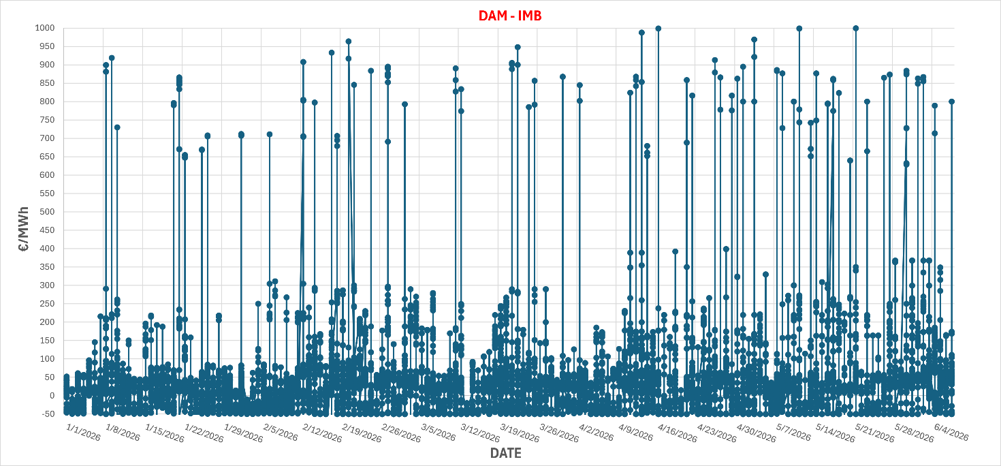
Balancing market prices in Greece frequently reach €999 per megawatt hour. When actual generation falls short of a scheduled position, SES has to buy the missing energy on the balancing market at the prevailing rate.

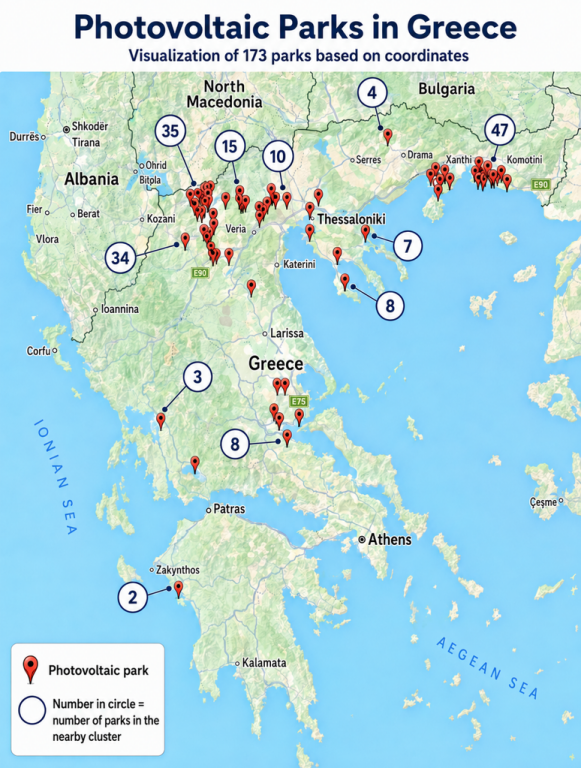
SES PV Parks in Greece map

Image courtesy of Solar Energy Soumpasis – displaying location of Solar Energy Soumpasis sites throughout Greece

The geographic makeup of the portfolio makes things harder. All 173 sites sit across a compact area of Central Macedonia – Thessaloniki, Florina, Kavala. That concentration means weather hits the whole portfolio at once. 

A dispersed portfolio provides some natural advantage as events affect different sites at different times, or perhaps not as severely. SES does not have that advantage. When cloud cover moves in across Central Macedonia, production drops sharply across the board, and the team has to respond fast.

That response plays out across three market windows. Bids go into the Day Ahead Market by midday the day before. Adjustments come in three intraday sessions at 4 p.m. and 11 p.m. the day before, and 11 a.m. on the day. At every one of those points, the team needs a current, accurate view of expected output.

However, the tools SES had previously used could not deliver the accuracy its market position demanded. A forecast of 80 megawatt hours might come in anywhere between 60 and 84 when the hour actually arrived.

Most forecasting tools are built around individual assets, telling an operator what one site will produce. However, SES has 173 sites and one grid submission covering all of them. What it needed was not another site-level forecast, but a portfolio-level forecasting solution capable of consolidating all assets into one reliable, continuously updated trading position. 

“Sudden and unpredictable weather changes are the biggest risk for our portfolio. Out of all the solutions we have worked with, Solargis Forecast Aggregation is by far the most accurate at capturing the sudden drops or spikes in solar generation in real time.”
Prifti Eris-Theodhoros
Mechanical Engineer, Solar Energy Soumpasis

The Solution

To address these challenges, SES adopted Solargis Forecast Aggregation.

Solargis Forecast’s Aggregation solution is designed specifically for operators managing multiple PV assets – not one site, but portfolios of any size, from a handful of installations to thousands.

For SES, the key advantage was the ability to transform 173 individual site forecasts into a single portfolio forecast that could be used directly for market bidding. The platform delivers a continuously updated portfolio forecast at sub-hourly resolution, refreshed every hour throughout the trading day.

All of the previous forecasting providers that SES have worked with offered some form of portfolio aggregation. What differentiated Solargis was the accuracy of that aggregated forecast, which is important for an operator trading across multiple market windows.

Solargis Forecast uses Cloud Motion Vector nowcasting reads real-time satellite imagery to track cloud movement and project it forward, giving the team an early signal of production drops before they show up in actual output. Numerical Weather Prediction models cover the day-ahead and longer horizons.

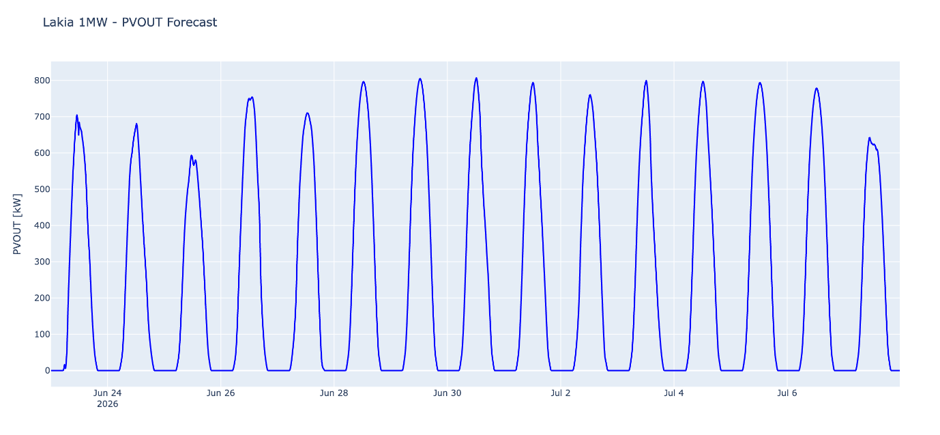
Lakia site Solargis Forecast

Solargis Forecast generated for a Solar Energy Soumpasis site

Together they give SES an accurate view across every time window that matters and, more importantly, they update fast enough to be actionable.

Solargis builds each site model from detailed plant configuration input, tracking systems, historical data, and exact location rather than approximating from a nearby weather station. This site-level precision underpins the reliability of the aggregated portfolio forecast. 

“When Solargis Forecast tells us we have 80 megawatt hours this hour, I believe them. That level of accuracy is a very difficult thing to achieve, and it is what we base our trading decisions on.”
Prifti Eris-Theodhoros
Mechanical Engineer, Solar Energy Soumpasis

The Outcome

The impact was visible within months of implementation.

Since adopting Solargis Forecast Aggregation, SES has recorded a 5–7% improvement in forecast accuracy against the alternatives available in the market it has previously used.

The financial impact of this improvement is an estimated 8–12% increase in fiscal outcome, driven by a reduction in balancing costs.  

Greek balancing prices move around, and the value of a well-timed trading call depends on market conditions in that moment Theodhoros insists that the direction is consistent.

“Solargis Forecast has given us much stronger protection against balancing risks,” says Theodhoros. “And it saves us a significant amount of time. For an operator of our size, both of those things matter enormously”

DAM IMB prices

Image courtesy of Solar Energy Soumpasis – displaying DAM-IMB prices recorded in the market from January 1, 2026, through June 7, 2026

When Solargis shows that the next hour's forecast is materially lower than the previous one, the team knows a weather change is coming. They can adjust their energy trading positions before the drop hits rather than after. The shift from reactive to proactive trading has become a key competitive advantage.

“Trading is a difficult sport, the precision Solargis Forecast gives us is what keeps us competitive - we are no longer reacting to weather, we are anticipating it.”
Prifti Eris-Theodhoros
Mechanical Engineer, Solar Energy Soumpasis

Conclusion

The aggregator model runs on the quality of the forecast. Get it right and you protect your producers, keep your grid submissions accurate, and capture value from the market. Get it wrong and it can mean you are buying missing energy at unpredictable balancing prices.

For SES, Solargis Forecast has delivered a 5-7% improvement in forecasting accuracy and an estimated 8-12% improvement in fiscal outcome through reduced imbalance exposure – alongside a trading operation that is positioned ahead of the weather rather than behind it.

In a market where the competition is ten times the size, forecasting precision has become a strategic advantage. For SES, that edge is as much a product of the team's own expertise and adaptability as it is of the solutions they deploy, and one that allows SES to stay a step ahead.

Products used#

Solar power output forecast for up to 14 days
Nowcasting every 15 minutes up to 3 hours
Minimize penalties from grid operators
Schedule maintenance based on the forecast
Manage the variability of your PV plant portfolio
SES improves forecasting, delivering double-digit financial gains with Solargis Forecast

Location

Greece, Europe


Product

Solargis Forecast


Service function

Portfolio aggregation forecasting to support grid scheduling, imbalance management, and energy trading


Outcomes

  • 5-7% improvement in forecasting accuracy versus alternative solutions

  • 8–12% improvement in fiscal outcome driven by reduced imbalance exposure

  • Time savings through anticipatory rather than reactive weather management